
A manufacturer in Vietnam specializing in high-end footwear materials and safety helmets was looking for a more reliable way to process thermoplastic polyurethane (TPU) into small, uniform pellets with consistent flow properties.
For downstream applications requiring precise processing, pellet size, moisture content, and material consistency can have a direct impact on production performance.
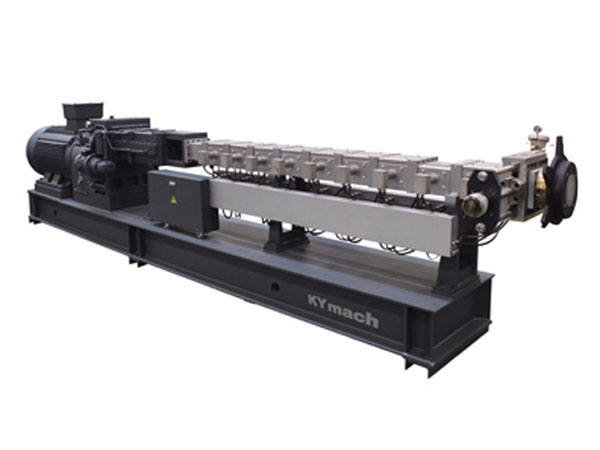
KYMACH analyzed the customer's material and production requirements and developed a customized TPU compounding and pelletizing system centered around an HK73 twin screw extruder.
The complete solution integrates material drying, automatic feeding, twin screw extrusion, underwater pelletizing, dewatering, drying, and centralized control into a coordinated production line.
TPU is widely used in footwear, protective products, and other demanding applications because of its combination of wear resistance, flexibility, and transparency.
At the same time, TPU processing requires careful control of material moisture and processing conditions.
The customer's original production system faced several practical challenges:
Insufficient raw material drying, resulting in bubbles and other defects
Unstable manual feeding ratios, affecting batch-to-batch consistency
Inconsistent pellet size, creating difficulties for downstream processing
A fragmented production process, resulting in higher labor and energy requirements
The customer therefore needed an integrated extrusion solution capable of providing more stable feeding, processing, and pelletizing conditions.
Based on the customer's requirements, KYMACH developed a customized TPU twin screw extrusion and pelletizing line.
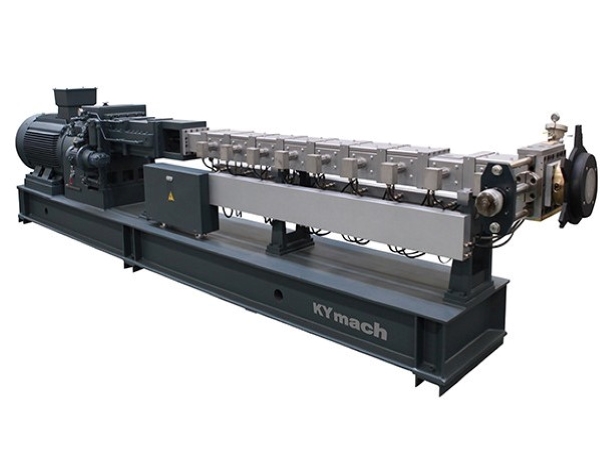
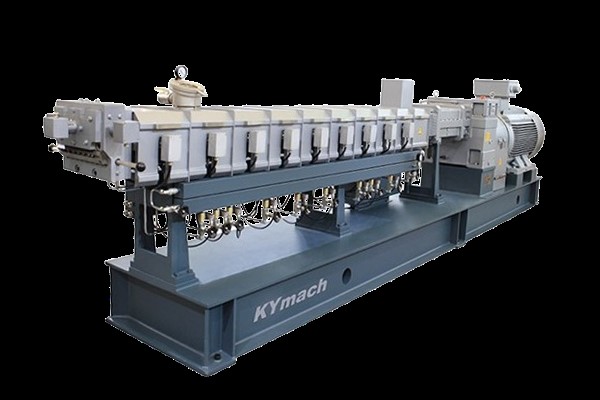
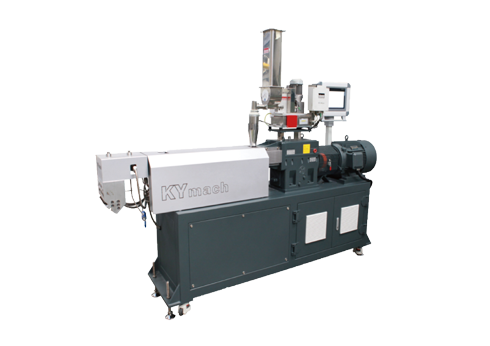
The system is built around the HK73 co-rotating twin screw extruder and integrates several auxiliary systems to create a continuous production process.
The HK73 twin screw extruder is configured with an L/D ratio of 48:1, providing sufficient process length for melting, mixing, homogenization, and process control.
The screw configuration is selected according to the characteristics of the TPU formulation and the required production conditions.
The twin screw design provides flexibility for adjusting the material conveying and mixing conditions to suit different TPU processing requirements.
Moisture control is particularly important when processing TPU.
The integrated raw material drying system removes moisture from the TPU feedstock before extrusion, helping reduce the risk of moisture-related defects such as bubbles during processing.
Stable material preparation provides a more consistent starting condition for the extrusion process.
To replace manual material feeding, KYMACH integrated loss-in-weight feeders into the production line.
The feeders continuously monitor material consumption and accurately control the feeding rate of individual components.
This provides improved control of:
Feeding rate
Formulation ratio
Batch consistency
Process stability
Automatic feeding also reduces the dependence on manual intervention during continuous production.
For the production of small TPU pellets, the system uses an underwater pelletizing system.
The pelletizing process is designed to produce a target pellet size of approximately 1.15–1.5 mm, providing a more consistent particle size for downstream applications.
Compared with conventional strand pelletizing, underwater pelletizing provides an integrated cutting and cooling process that is suitable for producing small polymer pellets under controlled conditions.
After cutting, the TPU pellets pass through a centrifugal dewatering system to remove surface water.
The subsequent drying process helps control pellet moisture before the material is transferred to downstream packaging or processing.
This is particularly important for TPU, where moisture control can influence subsequent processing performance.
KYMACH integrated the loss-in-weight feeding system, twin screw extruder, and underwater pelletizing system into a centralized control platform.
The mobile control panel allows operators to monitor and adjust the main production parameters from a single interface.
The integrated control system provides:
Real-time monitoring of the production process
Centralized process parameter adjustment
Faster response to production changes
Reduced manual intervention
Improved production consistency
By integrating the major process units into one control system, the production line becomes easier to operate and monitor.
The complete production line establishes a continuous process:
TPU Raw Material → Drying → Automatic Feeding → Twin Screw Extrusion → Underwater Pelletizing → Dewatering → Drying → Finished Micro Pellets
The resulting TPU micro pellets provide several potential advantages for downstream processing.
A controlled pellet size distribution can provide more consistent material feeding and melting behavior during subsequent injection molding or extrusion processes.
The combination of raw material drying and pellet dewatering/drying helps control moisture throughout the production process, reducing the risk of moisture-related defects during subsequent processing.
The relatively small pellet size can facilitate faster melting during downstream processing and may help improve material feeding and processing efficiency.
The twin screw extrusion process provides controlled melting, mixing, and homogenization, helping the TPU formulation achieve consistent material properties.
Automatic loss-in-weight feeding provides more stable control of formulation components compared with manual feeding, helping improve production consistency and reduce material variation.
This project demonstrates how a twin screw extruder and pelletizing system can be configured around the characteristics of a specific polymer and its downstream application.
For TPU processing, successful production depends on more than the extruder itself. Material drying, feeding accuracy, screw configuration, temperature control, pelletizing, dewatering, and overall process coordination all contribute to the final production result.
KYMACH combines twin screw extrusion technology, polymer compounding experience, pelletizing technology, and process engineering to develop customized solutions for different materials and applications.
With more than 30 years of experience in plastic compounding equipment, KYMACH provides integrated solutions for customers working with demanding polymer formulations and production requirements.
From material handling to extrusion and pelletizing, KYMACH helps customers turn specific material requirements into practical production solutions.
 Tel: +86-25-52706155
 E-mail: info@kymach.com
 No.59 West Tianyuan Road, Jiangning, Nanjing, Jiangsu Province, China
 English
  日本語
日本語  한국어
한국어  français
  Español
  русский
  português
  العربية
  中文
中文