
For KYMACH engineers, the production site is more than just a place to commission equipment. It is where process problems are understood, tested, and solved.
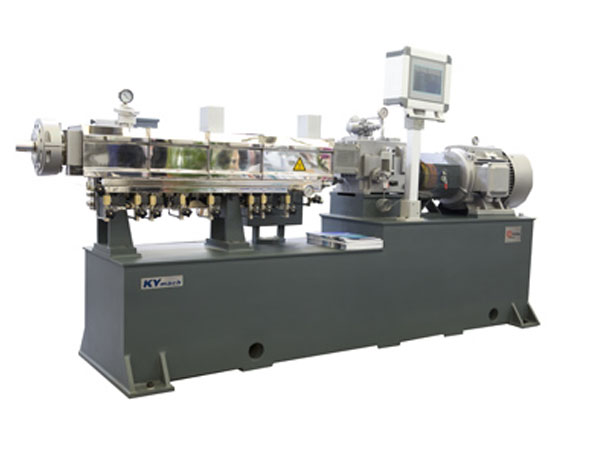
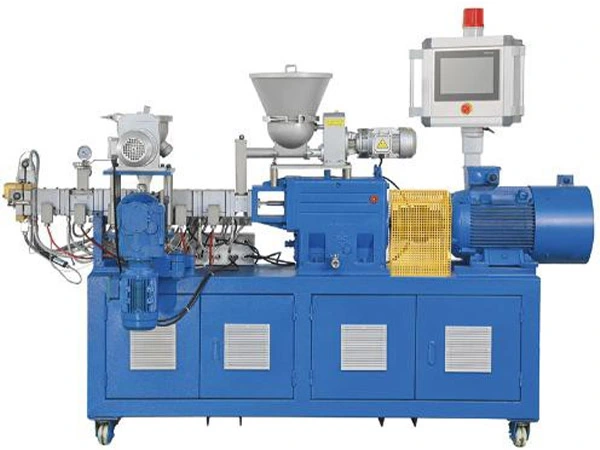
A customer had been using a KYMACH HK73 twin screw extrusion line to produce a specialized material for several years. The production process had been stable, and the equipment had consistently delivered reliable results.
However, as downstream requirements changed, the material formulation underwent a major adjustment. The proportion of the rubber component increased significantly, while functional fillers were introduced into the formulation.
This seemingly straightforward formulation change created a new processing challenge.
The increased rubber content made the material more elastic and prone to slipping inside the twin screw extruder, making it difficult to establish sufficient shear and conveying conditions. At the same time, the introduction of functional fillers placed higher demands on dispersion and mixing uniformity.
The equipment was familiar. The material was not.

The original screw configuration and process parameters had been developed for the previous formulation. Under the new material conditions, however, they were no longer sufficient.
Uneven mixing became one of the main obstacles to increasing production capacity.
This is a common challenge in polymer compounding: changing the formulation can change the entire processing behavior of a material, even when the extrusion equipment itself remains unchanged.
For this project, simply increasing the screw speed or feeding rate was not the solution. The process needed to be reconsidered from the perspective of material behavior, screw configuration, temperature control, feeding rate, and residence conditions.
After receiving the customer's feedback, KYMACH quickly arranged for a process engineer to travel to the customer's production site.
For screw configuration optimization, working with actual material on the actual machine is critical. Laboratory assumptions and theoretical calculations can provide a starting point, but the final process window needs to be verified under real production conditions.
Once the KYMACH engineer arrived, the production line effectively became a mobile process laboratory.
This on-site approach is an important part of KYMACH's technical service philosophy. Rather than treating commissioning as a standard equipment handover procedure, KYMACH engineers work directly with the customer's equipment, formulation, operating conditions, and production targets.
The objective is not simply to make the machine run.
It is to help the machine process the customer's specific material reliably.
For a twin screw extruder, screw configuration plays a critical role in determining how the material is conveyed, mixed, dispersed, and subjected to shear.
Every screw element has a role. The position and combination of conveying elements, kneading blocks, and other functional elements determine how the material behaves as it moves through the process section.
The same twin screw extruder can produce significantly different results when the screw configuration, temperature profile, feeding rate, or screw speed is changed.
For the new rubber-rich formulation, KYMACH engineers therefore focused on optimizing the screw configuration together with the main process parameters.
The adjustment process included evaluation and verification of:
Screw element arrangement
Mixing and dispersive sections
Feeding rate
Screw speed
Temperature profile
Material conveying behavior
Filler dispersion
Overall process stability
Rather than relying on a single parameter, the engineering team evaluated the interaction between these factors and gradually established a suitable operating window for this specific new formulation.
The first qualified pellets emerging from the production line marked an important milestone in the commissioning process.
After multiple rounds of adjustment and verification, the material achieved the customer's required quality standard, providing a practical solution to the mixing and processing challenges created by the new formulation.
The result was not achieved by changing the machine alone.
It came from matching the HK73 twin screw extruder configuration and process parameters to the actual material characteristics.
This is also why process optimization cannot always be separated from the equipment itself. In polymer compounding, equipment performance and process know-how work together.
The on-site commissioning also provided an opportunity to transfer practical knowledge to the customer's technical and operating teams.
During the commissioning process, KYMACH engineers conducted dedicated training covering topics such as:
The design logic behind twin screw configurations
The function of different screw elements
The relationship between screw speed and material processing
Key process parameters requiring adjustment
How process changes can affect mixing and dispersion
Practical considerations when processing different formulations
The purpose of this training was not simply to explain how to operate the machine.
It was to help the customer's team understand why process parameters need to be adjusted and how to evaluate the effect of those adjustments during production.
For KYMACH, equipment delivery is only one part of a successful polymer compounding project.
A high-performance twin screw extruder provides the hardware foundation. But stable production also depends on screw design, process parameters, material characteristics, commissioning experience, and the ability to respond to actual production conditions.
This is why KYMACH places strong emphasis on on-site technical support and process engineering.
From Nanjing to the customer's production floor, the physical distance may be significant. But when a process problem occurs, KYMACH engineers aim to shorten the distance between the problem and the solution.
The value of a twin screw extrusion system is not only in the precision of the equipment. It is also in the process capability and engineering support behind it.
For KYMACH, being on site means working alongside the customer, understanding the material, optimizing the process, and helping turn a challenging formulation into a stable production process.

Related News
 Tel: +86-25-52706155
 E-mail: info@kymach.com
 No.59 West Tianyuan Road, Jiangning, Nanjing, Jiangsu Province, China
 English
  日本語
日本語  한국어
한국어  français
  Español
  русский
  português
  العربية
  中文
中文